 Liberia Agricultural and Environmental Journalists Network (LAEJN) Promote informed journalism and public engagement on agricultural and environmental nalists Network (LAEJN)

By LAEJN Team
For generations, Liberia’s smallholder farmers have fought their way through the soil with little more than a hoe, a cutlass, and human labor. Today, machines are beginning to change that equation. Tractors, power tillers, and other agricultural equipment are allowing some farmers to prepare land in hours instead of days, cultivate larger areas, and move closer to a future where farming can become a business rather than simply a means of survival.
But as agricultural mechanization expands, a new question is emerging: What does Liberia’s agricultural boom mean for the smallholder farmers who have struggled for years to turn farming into a viable business?
For a woman farmer balancing production with household responsibilities, a young farmer searching for a viable livelihood, and an older farmer who has spent decades working the land by hand, the answer could reshape not only how farming is done, but who can afford to farm, how much they can produce, and what agriculture can mean for Liberia’s next generation.
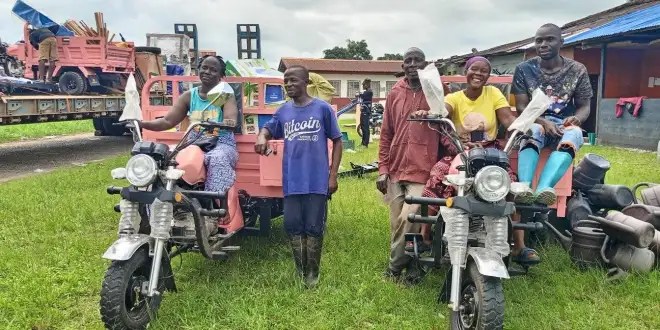
Tractors, power tillers and other farm machinery are gradually changing the way some farmers approach production. Tasks that once required several workers and days of strenuous labor can increasingly be completed with machines, giving farmers more time to plant, manage their crops and prepare for markets.
For smallholder farmers, the change could mark a gradual shift from farming primarily for household survival toward farming as a commercial livelihood.
Labor has long been one of the major constraints facing smallholder farmers.

Preparing several acres with hoes and cutlasses can take weeks, depending on the availability of workers and the condition of the land. Farmers who cannot mobilize enough labor may be forced to cultivate only a portion of the land available to them. Mechanization can help ease that constraint.
For women farmers, who often combine agricultural work with household responsibilities, reducing the amount of time and physical labor required for land preparation can be particularly significant.
“When the machine does the heavy work, I can spend more time taking care of my crops and looking for the market. It gives me a chance to think about farming as a business, not just producing food for my family.” Bandu Sackie, a Woman farmer in Menkormai, Town, Salala District, Bong
The value of mechanization, therefore, is not simply measured by the machine’s speed. It can also be measured by the time, labor and opportunities it makes available to farmers.
For young people, mechanization could also change the perception of agriculture. Farming has often been associated with physically demanding manual labor and limited economic opportunities. The increasing use of machinery introduces another dimension to agriculture—one involving equipment operation, farm management, technical services and commercial production.
“Young people want to farm, but many don’t want to spend weeks doing everything with a hoe and cutlass. If we have access to machines, financing and markets, farming can become something young people see as a real business.” Samuel Dahn, Chairperson, Youth Agriculture Farm in Meinpea Town, Nimba County
This does not mean machines will eliminate the need for labor. Instead, the nature of agricultural work may begin to change, creating demand for machine operators, mechanics, equipment-hiring services and other agricultural businesses.
When farmers can prepare land faster and reduce their dependence on manual labor, they may be able to cultivate larger areas and take greater advantage of planting windows. If that leads to increased marketable production, farmers can potentially generate more income and reinvest in their farms.
The Ministry of Agriculture is moving closer to completing 13 mechanization service centers across the country. The Ministry says the initiative is a major step toward transforming farming from a largely subsistence activity into a productive, commercially viable sector.
“When the centers are completed, we’ll bring in the machines to operate them and ensure they are functional,” Dr. Nuta told LAEJN in an exclusive interview. “By the end of 2026, Liberia will have 13 mechanization service centers spread across seven counties.”
The centers are being developed as part of a national drive to increase agricultural productivity, improve food security, and create opportunities for young people in agribusiness. The facilities will provide access to a range of machinery and services that many smallholder farmers cannot afford on their own, such as tractors, harvesters, and processing equipment.
To ensure sustainability, according to Dr. Nuetah, the government will not directly manage the centers but will operate them under a public-private partnership (PPP) arrangement. The Ministry of Agriculture has already issued a Request for Expression of Interest (REOI) to attract private sector actors who will manage the facilities, he said.
“The centers will remain government-owned but managed by private operators. The private sector will pay a percentage of the value of the equipment to run the centers, with a portion of the revenue reinvested into maintenance and operations. This way, the centers will be sustainable while still serving the needs of farmers,” Dr. Nuetah explained.
The minister stressed that this model is designed to avoid the pitfalls of past government-run initiatives that collapsed due to mismanagement and lack of upkeep. Under the new arrangement, private operators will have an incentive to ensure efficiency while keeping services affordable for farmers.
Liberia’s agriculture sector, which employs more than 70 percent of the population, has long struggled with low productivity, outdated farming methods, and limited access to modern tools. Mechanization is seen as a game-changer in addressing these challenges.
Dr. Nuetah noted that mechanization is central to his vision for a modern agricultural economy that can not only feed Liberians but also position the country as a regional food supplier.
“If I have just one more day at the Ministry of Agriculture, I want to ensure that mechanization is expanded,” he said. “This is the legacy I want to leave – moving Liberia beyond subsistence farming.”

Liberia Mechanization Ambition Aligns with African Union Call
At the African Summit on the Comprehensive Africa Agriculture Development Programme (CAADP) held in Kampala, Uganda, African Union Commission Chairperson Moussa Faki Mahamat made a bold call to retire the traditional hoe to museums, emphasizing the urgent need for mechanized farming across the continent.
In his address, the chairperson underscored that Africa’s reliance on manual farming tools, such as the hoe, continues to hinder agricultural productivity and economic growth. He stressed that in an era of technological advancement, African nations must fully embrace modern agricultural machinery to boost food production, ensure food security, and improve farmers’ livelihoods.
“The hoe has served its purpose, but it should now belong in museums. Our farmers deserve better tools to increase productivity and compete on a global scale. It is time for Africa to move beyond subsistence farming and invest in mechanization,” he stated.
The call for mechanization aligns with the CAADP’s broader goal of transforming Africa’s agricultural sector by promoting investments in modern farming techniques, irrigation systems, and agro-processing industries. Many African nations continue to struggle with low agricultural output due to outdated farming methods, limited access to mechanized tools, and inadequate infrastructure.
The remarks received strong support from agricultural stakeholders, policymakers, and development partners present at the summit, many of whom echoed the need for governments to prioritize policies that facilitate farmers’ access to tractors, harvesters, and other advanced farming equipment.
The summit also highlighted successful case studies from countries that have made significant progress in mechanization, showing how investments in modern tools have led to increased crop yields and economic growth. Experts at the event urged African governments to establish public-private partnerships and mobilize resources to ensure farmers, particularly smallholders, can afford and access mechanized solutions.
As Africa works toward achieving food self-sufficiency and agricultural transformation, the call to retire the hoe symbolizes a broader shift towards modernization, efficiency, and economic empowerment for millions of farmers across the continent.


